Showing posts with label Revell. Show all posts

Sunday, April 5, 2015

Model #6 Revell Wright Flyer 1:39

The Wright Brothers legacy as aviation pioneers is one of the most famous stories you've never heard about.


Their inaugural flight at Kittyhawk is rightfully well known, but their accomplishments and failures are far more compelling than their famous but otherwise pedestrian flight.

The reality is a significant portion of the technology used on their original flyer was already well known. Even their patented wing-warping wasn't momentously groundbreaking. One of their most important contributions is their realization that a propeller is actually a wing in rotation. Their contemporaries mistakenly considered propellers to be like their water based cousins, pushing water back to nudge a boat forward. The Wrights ingeniously discovered the characteristics of lift could be applied vertically as well as horizontally. Further, their wind tunnel tests were strikingly accurate, with their propellers achieving nearly 80% efficiency. After a hundred years of research and enormous advances in technology, modern propellers achieve roughly 85%. For the Wrights to be so close on their first attempt is truly amazing.

Speaking of amazing, I'll shut up and get back to the model.

This one had a number of intricate parts and required all of the limited skill I had. I began with Charlie Taylor's engine, which is much easier to detail prior to installation. I kept it simple:
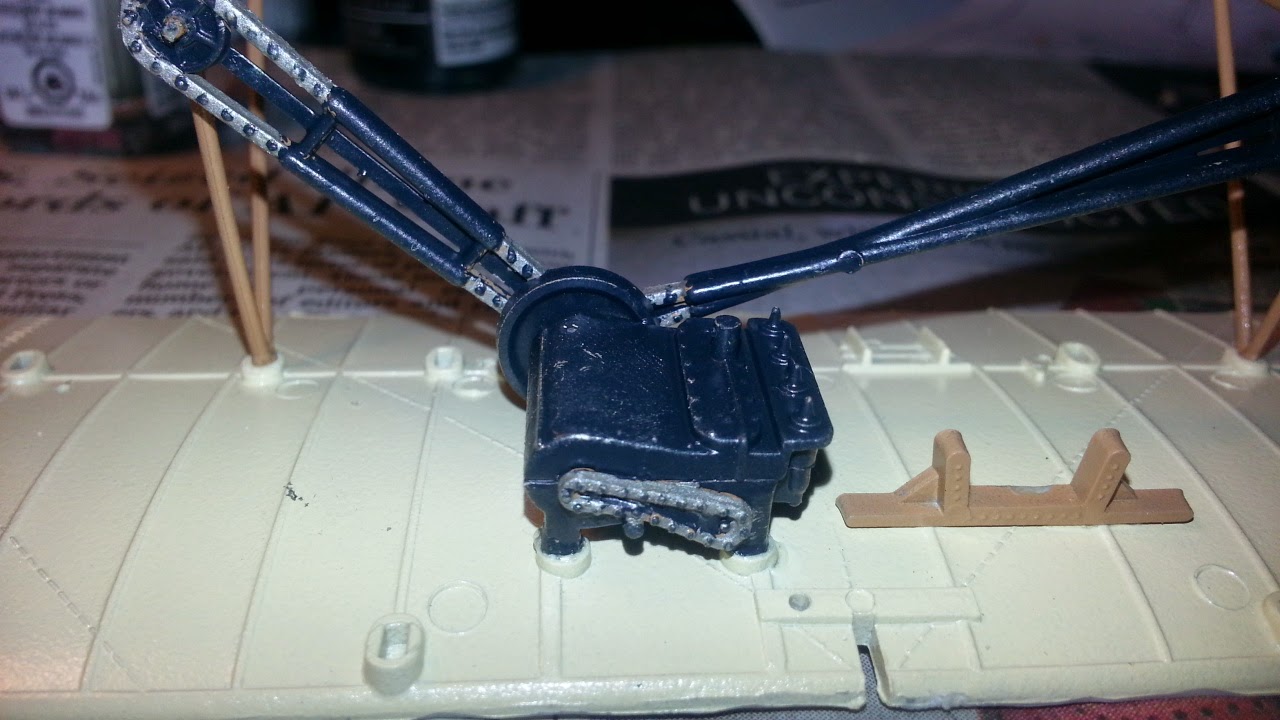


(ProTip: Don't forget to paint the strut mounts before assembling the wings like I did. In fact, you're better off painting everything before assembly.)

Everyone has an opinion on what their most vital piece of modeling equipment is. See if you can spot mine:


Here you can see the control mechanism on the canard. Ironically, it was the Wrights' self-destructive obsession with enforcing their flight control patent that allowed others to surpass them by orders of magnitude in the user friendly department. (The Wrights feared embracing new technology would weaken their case.) Even before they they won, and lost, and won and lost their lawsuit, their flight control system was laughably antiquated and was despised by pilots as counterintuitive, complicated, and unsafe.


None of these three parts were especially easy to assemble, but the worst was yet to come.


The most difficult part of this model was the installation of the control wires. This string became the bane of my existence and was a true pain in the ass. Revell gives detailed instructions and even goes as far as stating "patience" is required. I can't say I've ever seen a manufacturer give a pep talk in their modeling instructions before.


Revell designed this kit with a hook and loop system to run the string through the interplane struts, in addition to threading it through tiny holes in the wings.


Personally, I consider time to be a precious commodity so I cheated to speed up the process. I used Insta-Set to quickly lock the string in place. I'm not attempting to build a museum quality piece, and this method worked just fine for my standards.


In the end, the string really tried my patience and I was very happy to finish this one. Overall, I'm satisfied with the way this model turned out.


This is about as much cockpit detail as you're going to get out of me. (Not bad considering, as a result of my poor planning, I had to paint it after assembly.)


This shows a little more of the complex string work required.


It looks just fine on the shelf next to my Goose project.


The Wrights are justifiably honored as aviation greats. They weren't just pioneers, but brilliant creators as well. Unfortunately, their most impressive contributions to aviation are overlooked by most. Likewise, their obstinance and pettiness is often dismissed or glossed over. Their lack of vision not only contributed to their relative failures as businessmen, but their unjustified litigious assault on anyone even remotely involved in creating new aviation technology most likely stalled progress in the field.

Revell delivered for me on this kit. As big a pain as the string was, I don't think there's any other way it could have been done. To their credit, the directions were as clear as possible and the parts fit well. It's unfortunate they don't make this in a 48 scale, though I'm unlikely to attempt this one again if they ever do.

I was ready for an easy project after this one, but I'm glad I did it. If I'm going to build a collection of historically significant aircraft, I obviously had to include the one that started it all.

Happy building!

While the Glue is Drying:
  
Revell includes a color photo pamphlet in this kit that offers several tips, including for building a diorama. It's worth a look and will probably be appreciated by more skilled modelers. They also include two figures, the original ramp, and other accessories so you can recreate the famous picture of the first flight. That's not my thing, but someone over at Airfix forum has a nice example.

Sunday, October 19, 2014

Model #5 Revell Bell X-1 1:32

For historically important achievements in aviation it's tough to beat breaking the sound barrier. The Bell X-1 was a must have on my build list.


While I was building my Rutan Voyager model I was inspired to focus my modeling hobby on planes that made a significant impact on aviation. The X-1 clearly foots the bill for those purposes. Further, after the struggles I had with the Goose project I was looking for a simple, straightforward model to get me back in the groove. Revell came to the rescue with this austere kit. 

The sound barrier had been an elusive goal for aerodynamicists for decades. Despite having the raw horsepower to achieve mach speed, the structural technology to reach this velocity was far more complex than one might expect. The problem lay not in the subsonic, or even supersonic range, but rather the "in between" zone, or transonic range of speed.  

Transonic flight occurs when some of the airflow over a wing is supersonic while the rest is flowing at subsonic speeds. This difference in airflow pressure and speeds causes violent oscillations (shaking). This powerful shakeup at transonic speeds directly led to the death of aviation great Geoffrey de Havelland Jr. during his test flight of a DH 108

Ultimately, the X-1 overcame this problem with a counter-counter-intuitive solution.

Originally, the Wright Brothers (and hundreds that followed them) designed wings as thin as possible to "slice" through the air and reduce drag. As the study of aerodynamics matured this proved to be a flawed idea.

The Fokker D7 turned aviation on its head by using a thick wing without losing any positive lift characteristics. This thick wing led to a revolution in plane design. The elimination of the second wing of a biplane (and accompanying bracing struts) was the result of a (singular) thick wing design. And once a wing is thick enough, you can hide wheels and landing gear and fuel inside of it (further eliminating drag).

With the seemingly unbreakable sound barrier posing a problem, aviation would come full circle and return to a razor thin wing profile. By reducing the thickness of a wing, you can reduce the ability of shockwaves to take hold, and therefore reduce the oscillations created during transonic flight. 


This Revell kit is everything you'd expect from a Revell kit. It's simple, easy to build, and almost frustration free. I did have some fit issues, but someone with pride and patience could have corrected them with simple putty and sanding. As you can see, I am not that person. 


There's not much to say about putting this model together. The interior is sparse, there's an engine you can build (that won't be seen once it's enclosed), there's wings, a fuselage, a pitot tube and antennae. That's about it. Pro Tip: I added a ton of weight in the nose. Despite its looks this plane is tail heavy. 

The landing gear is probably the most complicated part of this kit, and even that was easy:


The hatch is technically removable, though I damaged the paint when I pulled it off to take this picture. Regardless, there is somewhat of a view inside the spartan cockpit. (Not shown is the broomstick Revell included in the kit. A nice touch and a nod to the history of Yeager's flight, and one I have a familial connection to that I'll share sometime.)


This model offered good bang for the buck. The color makes it a striking addition to my collection. It was simple to build and looks totes cool. I'm happy with the final product:


You may not believe this, but the top view is just as orange as the side view. (I used a 3oz can of Model Master Go Mango 2970).


This kit taught me that some of the easiest builds can be the coolest ones. In the modelling world we're bombarded with DETAIL! DETAIL! DETAIL! nonsense. I'm not going to begrudge people with enough time to worry about rivet layouts and valve stem colors for doing their thing. But for my time and dollar I'm happy to put together a cool looking plane that doesn't drive me nuts building it and displays nicely. Typically Revell produces that for me and this model was no exception. 


Happy building!


While the Glue is drying:

Check out a beautiful version of the same kit by reading this guy's review..  

Tuesday, January 7, 2014

Model #2: Revell F4U-4 Corsair 1:48

The Vought F4U is one of the most distinct planes of the WWII era and its striking lines make it hard to pass up for hobbyists. The inverted gull wings make the F4U easy to pick out from a mile away. The plane's significance as an integral part of Pappy Boyington's famed Black Sheep squadron makes this an irresistible candidate for a scale model build.


Every little boy knows the Revell name, and the reason why was obvious as soon as I opened the box. The parts were easy to identify on the sprue and the directions were clear. The design was complicated compared to my previous model, but the manageable size made this project far more enjoyable to put together.

One of the cool things about this model was the true-to-life folding wings. Unfortunately, I couldn't make mine work. Despite the overall quality of the model, the "hinges" for the wings were inadequate and unaligned. The tapered fit between the wing and fuselage didn't work either. After a ton of sanding and cutting, I was able to make them work (fold up and down). That said, the design was so flimsy, after a few rotations, both wings ended up breaking off.

I suspect a more experienced modeler would have been more successful, but that wasn't the case with me.

Here you can see my original (cutting) efforts at creating clearance for the wings to oscillate, and also the final solution of heavy glue to keep them attached to the rest of the model:


Although seemingly as delicate as the wing joints, the operable doors for the tailwheel are still working spot on. The wheel (and hook) both operate with a full range of motion and can be stowed away:


I also had a problem with the canopy. There was simply no way for this to fit. It either fit one half of the cockpit with a gap on the other (starboard) side, or it smooshed down on the pilots head and fell underneath the airframe. Luckily, I had picked up some of Testors clear parts cement and I was able to fill it in. Not a bad fix for a second timer!


The Corsair F4U is heavily armed, and I had fun building and painting the various missiles and bombs (with varying degrees of success):


I hand brushed Testors Burnt Iron for the cylinder heads and I liked the effect (Yes: I probably should have dusted her off before taking pics):


I'm pretty satisfied with the final product:


From the front, showing off the infamously massive 13-1/2 foot Hamilton Standard prop:


In conclusion, I had a lot of fun building this Corsair. The 1:48 was a much more agreeable scale to my skill level. In consideration of my space requirements and talent level I decided at this point to stick with the scale. For whatever reason, I actually enjoyed overcoming some of the minor obstacles I encountered on this build. I was excited to figure out a fix for the window. I didn't let the wing problems get the better of me, because things break, and this ain't going in a museum.

I struggled with painting the "frame" supports on the canopy, but it taught me that I needed better tools and I now own a fine set of size 0 and similar brushes for all sorts of detail work. I've noticed since this build that my knowledge grows exponentially with each project.

I screwed up the decals and selected a poor choice of paint color. I'm over it. I had a lot of fun building this one and it still looks great on the shelf.


Happy building!

Jeff


While The Glue is Drying:

This guy over at ARC built this model right. And he got his wings to work!